Introduction:
A website is supposed to be a business’s hardest online working employee, open 24 hours a day, never calling in sick. Yet most small business websites lose the majority of their visitors within the first ten seconds, long before anyone reads a word of copy or sees a single product.
The small business website exists, the domain is paid for, the logo looks fine, but visitors leave almost as fast as they arrive. Let’s break down why so many small business websites fail at the exact moment they’re supposed to convert, what it’s quietly costing owners who assume “the website is done,” and how to fix it in plain, everyday language.
Table of Contents
🔎 Why Do Small Business Websites Lose Visitors So Fast?
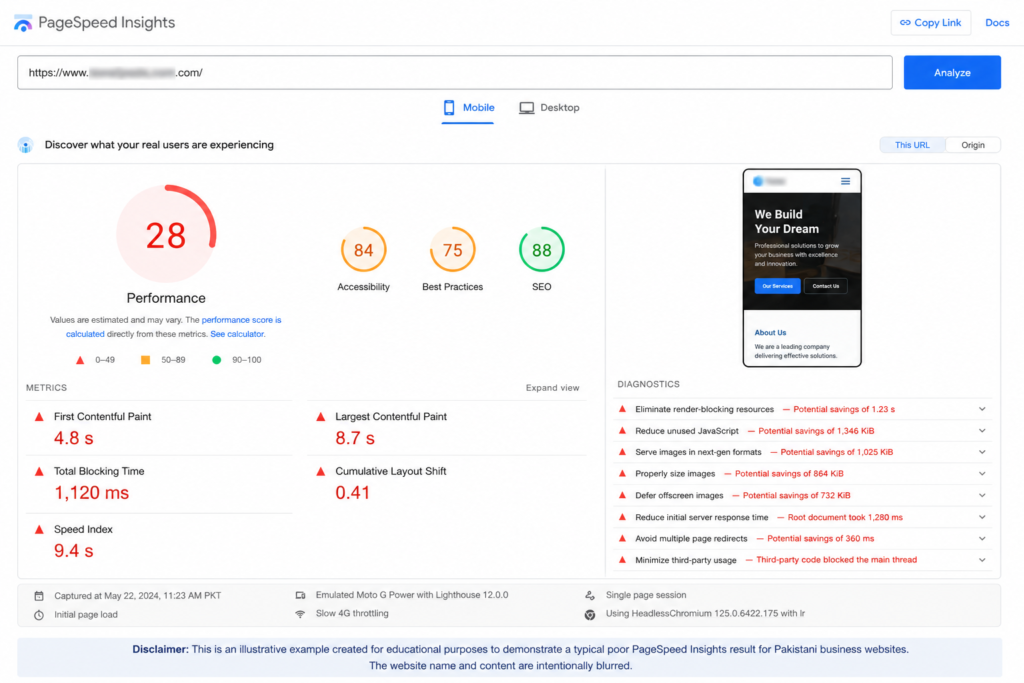
1. Slow Load Times: Many small business websites take five, six, even ten seconds to load, especially on mobile. Visitors don’t wait around to find out if it was worth it.
It’s like a shop with a door that takes ten seconds to unlock every time someone tries to walk in. Most people just try the shop next door instead.
2. Unclear Above-the-Fold Messaging: The first thing a visitor sees is often a vague slogan or a generic stock photo, with no clear statement of what the business actually does or who it’s for. Confused visitors don’t stick around to figure it out.
It’s like walking past a shopfront with no sign, no window display, and no idea what’s sold inside. You keep walking.
3. Templates Built for Nobody in Particular: Many small business websites are built from a generic template and never adjusted to fit the actual business, its services, or its customers. The layout looks fine but says nothing specific.
It’s like wearing a suit off the rack that was never tailored. It technically fits, but it doesn’t look like it was made for you.
4. No Clear Call to Action: Visitors land on a homepage full of information but with no obvious next step, no visible phone number, no booking button, no simple contact form above the fold. They read, get interested, and then have to hunt for how to actually reach the business.
It’s like a helpful shop assistant who explains every product perfectly, then walks away right when you’re ready to buy.
5. Broken Mobile Experience: A large share of visitors arrive on a phone, yet many small business websites were only ever tested on a desktop screen. Buttons overlap, text runs off the edge, and forms are painful to fill out with a thumb.
It’s like handing someone a map that only makes sense if they’re standing exactly where you were standing when you drew it.
6. Treating Launch as the Finish Line: A website goes live and is then left untouched for years, no new content, no updated services, no fixed broken links. Visitors, and Google, both notice when a site looks abandoned.
It’s like opening a shop once for the ribbon-cutting and never restocking the shelves again.
📊 The Impact on Small Business Websites
A website that loses visitors in the first ten seconds isn’t just a design issue. It shows up directly in lost revenue:
Wasted Marketing Spend →Every ad click or social share that lands on a weak site is money spent for nothing.
Lower Search Rankings → Google factors in speed and mobile usability directly into where a site ranks.
Lost Trust → A slow, unclear, or broken site makes an otherwise good business look unprofessional before a customer ever speaks to anyone.
Fewer Conversions Per Visitor → Even the traffic that does arrive converts at a much lower rate without a clear message and an obvious next step.
If visitors leave before they understand what you do, it doesn’t matter how good the business actually is.
✅ How to Fix It
None of this requires a full rebuild from scratch, just a focused pass on the fundamentals. Here’s a simple action plan:
1. Get the Site Loading Fast
– Test your site with Google PageSpeed Insights (https://pagespeed.web.dev/) and aim for a mobile score above 95.
– Compress images, remove unused plugins, and use a content delivery network like Cloudflare.
2. Fix the First Screen
– State clearly, in one sentence, what you do and who it’s for, above the fold.
– Replace generic stock photography with real photos of your business, team, or work whenever possible.
3. Make the Next Step Obvious
– Add a visible phone number, WhatsApp link, or contact form near the top of every page.
– Use one clear call-to-action button rather than five competing ones.
4. Design Mobile-First, Not Mobile-Last
– Test every page on an actual phone, not just by resizing a browser window.
– Use Google’s [Mobile-Friendly Test] to catch usability issues early.
5. Treat the Website as Ongoing, Not One Time
– Update service pages, pricing, and offers as the business changes.
– Check for and fix broken links every few months.
Reach Solver’s own web development service is built around exactly this checklist, fast-loading, mobile-first, conversion-focused, delivered in a fixed timeline rather than treated as a one-off project.
🛠 Test Your Own Website
Open your own website on your phone, on mobile data rather than WiFi, and time how long it takes to understand what the business does and how to contact it. If it takes longer than ten seconds, or if you have to scroll and think about it, that’s exactly what a first-time visitor is experiencing. You can get a fuller picture with Reach Solver’s free [Website Cost Estimator], which also flags common issues worth fixing before investing in a rebuild.
📢 At ReachSolver, we help small businesses build websites that people actually stay on. If your site is slow, unclear, or hard to use on a phone, don’t wait for the next slow quarter to fix it. 👉 Contact ReachSolver, today for a free website audit. We’ll show you exactly where visitors are dropping off and how to fix it, in plain language, with real results.
Conclusion:
Losing visitors in the first ten seconds usually isn’t about a business being unappealing. It’s about a website that never got tuned to load fast, communicate clearly, and make the next step obvious. In a market where attention spans are shrinking, a website has less time than ever to make its case.
By fixing load times, clarifying the first screen, making the next step obvious, designing mobile-first, and treating the site as an ongoing asset, small businesses can:
– Keep more of the visitors they’re already paying to attract.
– Rank higher in search results as a direct result of better technical health.
– Convert a larger share of traffic without spending more on ads.
– Build a website that keeps working rather than quietly going stale.
A well-built small business website is like a shop with a wide open door, a clear sign, and a friendly assistant standing right there to help. Visitors don’t have to work to become customers.