Introduction:
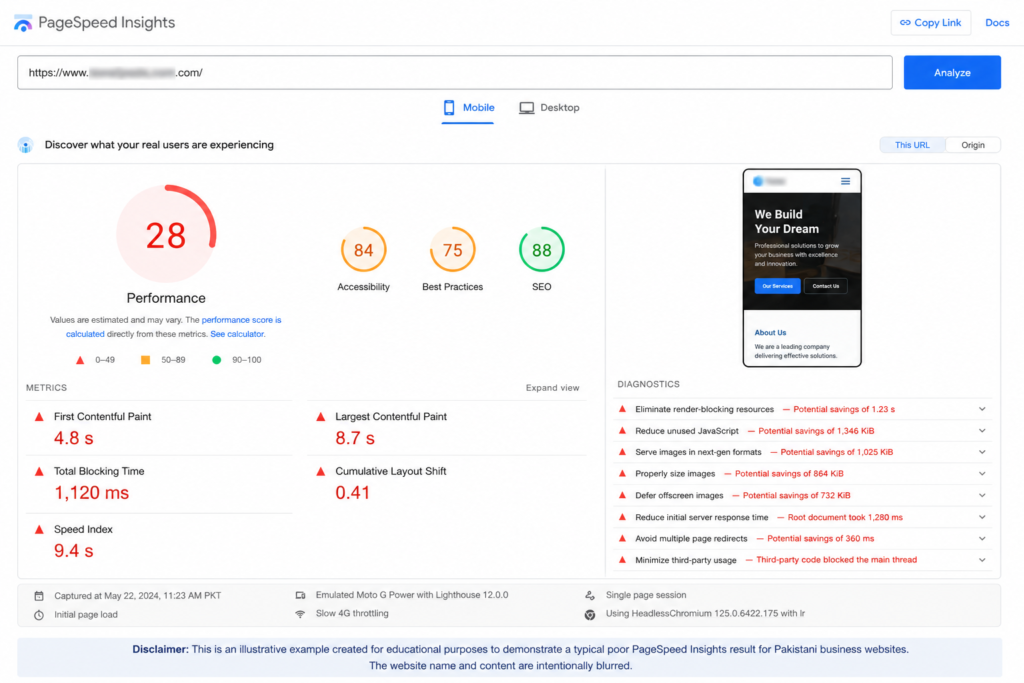
Google PageSpeed Test is the lifeblood of the internet. A slow website is like a shop with a jammed door, customers don’t wait, they move on. Google also punishes slow sites by pushing them down in search results. Sadly, studies show that around 75% of Pakistani business websites fail Google’s PageSpeed / Core Web Vitals tests.
This failure is costing businesses traffic, sales, and credibility. Let’s break down why this happens, what it means for businesses, and how to fix it in plain, everyday language.
Table of Contents
🔎 Why Do So Many Pakistani Business Websites Fail Google PageSpeed Tests?
1. Heavy Image: Most sites use oversized, uncompressed images. A single banner can be 2–3 MB, which is painful for mobile users. Without resizing or converting to modern formats like WebP, the site drags.
Think of it like sending a huge photo over WhatsApp on weak data — it takes forever. That’s what visitors feel when your homepage loads giant images.
2. Cheap Hosting: Businesses often pick the cheapest hosting packages. These shared servers are usually abroad, and when too many sites share the same server, your site slows down.
It’s like living in a crowded apartment with one water line. When everyone turns on their taps, your water pressure drops.
3. Bloated WordPress Themes & Plugins: WordPress is popular, but most themes come loaded with extra scripts and plugins. These add unnecessary CSS and JavaScript files that block quick loading.
It’s like carrying a school bag full of books you don’t need. The extra weight slows you down.
4. Poor Mobile Experience: More than half of internet users in Pakistan browse on mobile. Yet many sites aren’t mobile‑friendly. Fonts are tiny, buttons are hard to click, and layouts break on small screens.
It’s like trying to read a newspaper folded into a tiny pocket size. You can’t see anything clearly.
5. Layout Shifts (CLS Errors): Ever seen a page where text jumps around because ads or images load late? That’s called Cumulative Layout Shift (CLS). It makes the site look broken and frustrates users.
It’s like sitting on a chair that keeps sliding away every time you try to sit. Annoying, right?
6. Too Much JavaScript: Modern sites often rely on heavy JavaScript frameworks. If not optimized, they slow down the site and confuse Google’s crawler.
It’s like having too many cooks in the kitchen. Everyone is busy, but the food takes longer to come out.
📊 The Impact on Businesses
Failing PageSpeed tests / Core Web Vitals, is not just a tech issue. It directly affects your business:
- Lower Google Rankings → Slow sites don’t show up on page one.
- Lost Customers → Mobile users leave within seconds if the site doesn’t load.
- Higher Costs → Businesses spend more on ads to make up for lost SEO traffic.
- Reduced Trust → A slow site makes your brand look unprofessional.
If your shop door is jammed and customers struggle to enter, they’ll go to the shop next door.
✅ How to Fix It
The good news? These problems are fixable. Below is a simple action plan & here is link to Tools which can Help You:
- Optimize Images
- Convert to WebP format.
- Compress with free tools like TinyPNG.
- Resize images to match display size.
- Upgrade Hosting
- Avoid the cheapest shared hosting.
- Use VPS or cloud hosting with servers closer to Pakistan.
- Add a CDN like Cloudflare (free) to speed up delivery.
- Streamline Plugins
- Remove unused WordPress plugins.
- Defer non‑critical JavaScript.
- Inline critical CSS.
- Mobile‑First Design
- Test with Google’s Mobile‑Friendly tool.
- Use responsive layouts.
- Make buttons and text easy to use on small screens.
- Fix Core Web Vitals
- Focus on LCP (Largest Contentful Paint), INP (Interaction to Next Paint), and CLS (Cumulative Layout Shift).
- Preload key resources.
- Reserve space for ads and images to avoid layout jumps.
🛠 Test Your Own Website
Instead of comparing another business, check your own website using Google PageSpeed Insights: https://pagespeed.web.dev/. If your mobile performance score is below 90, your site likely has speed issues that can impact both Google rankings and user experience.
Conclusion
Failing PageSpeed tests is not just about slow websites. It’s about lost opportunities of website speed optimization. In a world where customers expect instant results, speed equals trust. Pakistani businesses must treat website performance as seriously as branding or customer service.
By fixing images, upgrading hosting, and focusing on mobile‑first design, companies can:
- Rank higher on Google.
- Attract more leads.
- Build trust with customers.
- Save money on ads.
A fast website is like a clean, well‑lit shop with an open door. Customers walk in, stay longer, and buy more. Check is you website is also failing as most Pakistani Business Websites Fail Google PageSpeed Tests?
📢 At ReachSolver.com, we help businesses improve their online presence. If your website is slow or failing Google’s PageSpeed test, don’t wait until customers leave.
👉 Contact ReachSolver today for a free website audit. We’ll show you exactly what’s wrong and how to fix it, in plain language, with real results.
Website Design, SEO, Core Web Vitals, Google Business Profile